On the Up Grade
30.4 – 2.5.2026 7:30pm – 9pm
1 – 3.5.2026 3pm – 4:30pm
F Hall Studio & Prison Yard
HK$280
Remarks
- Duration: approximately 1 hour 30 minutes without interval
- No latecomers will be admitted
- Recommended for ages 6 and above
- Audience is required to walk around various locations during the performance. Comfortable clothing is recommended and please assess your physical condition if it is suitable for participation
- Programmes are subject to change without prior notice. Tai Kwun reserves the right to make the final decision regarding the arrangements.
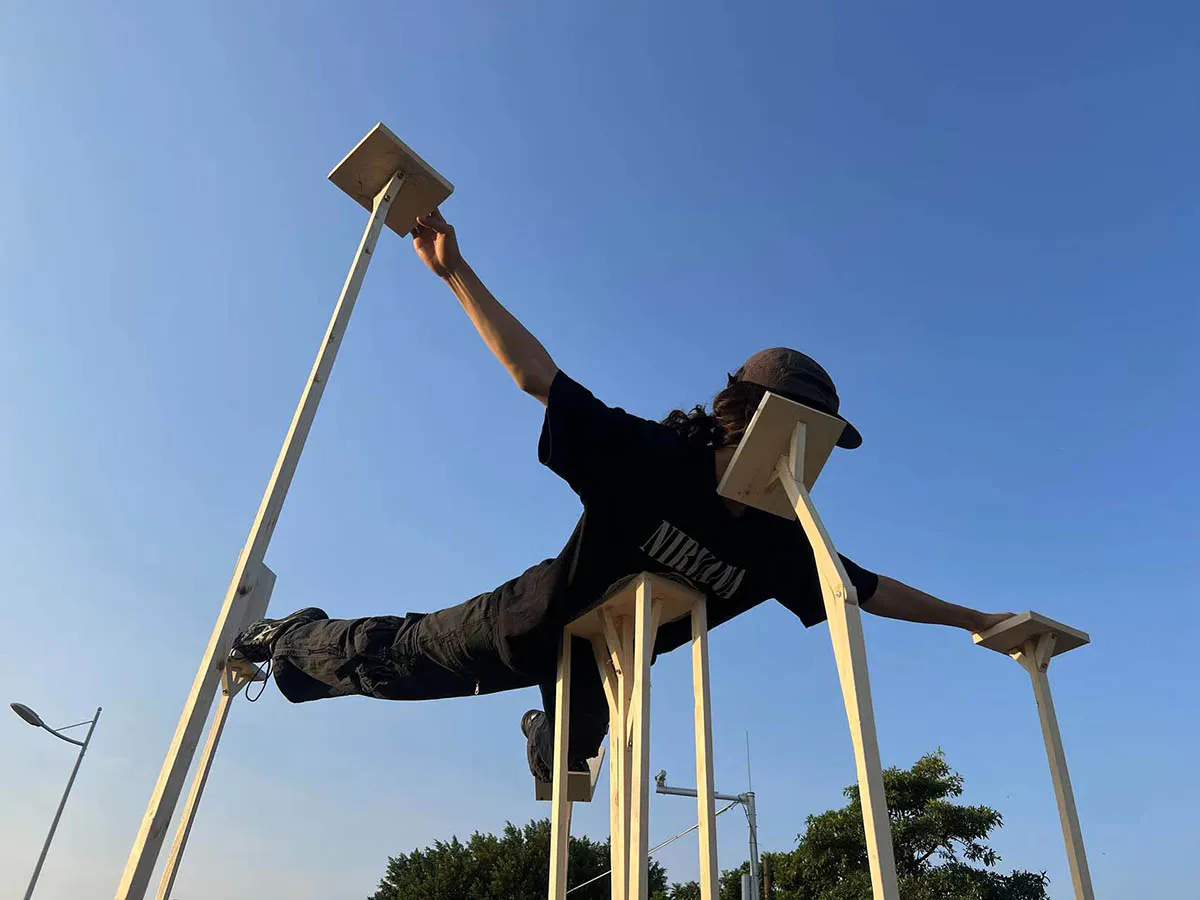
When I first spoke with Tai Kwun about On The Up Grade, we discussed the idea of ritual that exists between the virtual and the real. At the same time, through my years of everyday exchanges with my artistic advisor, Cao Fei, I became particularly attentive to a phenomenon they share: the hours-long “product-selling performances” of contemporary online livestreaming, the spirit possession of ritual mediums in traditional folk practices, and the state professional dancers seek in performance, when a “third eye” allows them to see themselves. All of these seem to share a commonality—they are forms of what I would call “possession-style performance.” I have been especially drawn to the continual rise and fall of the body within these processes.
This fascination found its response during one walk near my home, in Xiaobei—known as the “World City of South China.”
It was after 11 p.m. that night; it was already late. My friends and I walked along Xiaobei Road, surrounded by all kinds of stalls and roaming vendors, voices clamouring in every direction. Africans, Arabs, Turks and people from other provinces gathered here together. It felt as if we had suddenly stumbled into a city that never sleeps. Wonderful! All those thoughts about ritual, out-of-body experiences, and “product-selling performances” suddenly found a place to land in Xiaobei—it is a place where strangers of many races and nationalities live side by side. Identities are blended together here in the form of a kind of “possession-style performance,” visibly enacted in this space.
I began coming to Xiaobei to shop, buying wax prints—bursts of vivid colour, an endless variety of patterns. Once I touched them, I realized that the texture of each piece of fabric was different: some soft, some stiff; each shaped the body in its own way. I also began studying the design logic of the various patterns and the meanings behind them. I quickly discovered that although these patterns may originally have been created simply to sell better, each person who handles them continually imbues them with new stories, which are then passed on to consumers. This process of constant reproduction, endlessly infused with new content, gives them vitality, allowing them to flow into the lives of different people. This is the part I find especially captivating.
From buying fabric, getting haircuts and picking up sandwiches, to learning Ghanaian dances, to bringing wax prints into villages and communities in Shunde, where we exchanged with local women who make handicrafts at home to supplement their income, we produced bags, badges, T-shirts, and suits together. Through these close interactions with the women, I developed an interwoven emotional bond with these fabrics.
In the end, I hope that everyone who comes to see the performance will not only see wax print textiles, but also see the neighbourhood I live in, the communities I share my life with, and a celebratory ritual of a world shop and pedestrian street as I imagine it.
Thanks to: HE Interaction, Zuotan village,De Ya Lu Men Bookstore, Hao Space, Mama’s Remake, Wain, Shunxu, Jiao, Mei
In Praise of Batik Fabric
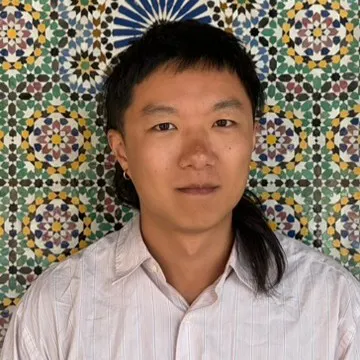
ErGao (He Qiwo) was exploring the African communities along Xiaobei Road in Guangzhou one day when he came across batik fabric. He was instantly captivated by the energetic colours: “All these bold and vibrant colours feel very African, yet there is also a hint of ethnic flavour.” ErGao’s sense of curiosity and wonder triggered his creative urge, and he started to visit Xiaobei Road often to gather more material. He made friends there through getting haircuts and fabrics: “After making many purchases of these fabrics, the shop owner started chatting with me.” The Chinese shopkeeper’s clientele consisted mostly of Africans who would send the fabric back to resell back home. Some patterns were specified by customers while others were found online, with each design carrying its own unique meaning.
ErGao sees more than just hues of colours in each piece of batik fabric. He initially assumed batik fabric is associated exclusively with Africa, but that was not the case. With a colonial history and sense of mobility as if having a life on its own, batik had spread across Indonesia, the Netherlands, Africa and elsewhere. Everywhere it went, it gave rise to new stories about the land. Later, it became “Made in China”—with new patterns and styles of batik produced in China and exported back to Africa. The colours are certainly attractive, but what fascinates him most is the sense of displacement.
In On the Up Grade, the fabric takes centre stage in F Hall Studio. Dancers, clad in batik fabric, echo the figures in VFX green-screen suits in the video. The latter is seamlessly overlaid with other visuals including scenes from Xiaobei Road, blurring the human form. “I want to connect different spaces, transcending the ‘boundaries’ between realms.” The choreography blends movements inspired by African dance, Wing Chun and nunchaku, which the audience may find vaguely familiar. “They are not exclusive to any one particular culture. Just like the internet and technology today.”
In these movements, the audience can find connections with their own lives whilst glimpsing into ancient and distant traditions. Elements of the near future, technology, ritual, tradition and multiculturalism are juxtaposed in the production. “It seems anything can be livestreamed nowadays. This is not unlike ancient witchcraft and rituals where people seemed to be praying for something.” The dancers are performing around instead of towards the audience, allowing the audience to be more relaxed and at ease as if enjoying an exhibition. The fifty minutes spent in F Hall Studio are deeply engaging and the audience feels no burden to extract any specific message or meaning from it. “The audience are participants, not detached outsiders, and become part of the experience. This intimacy is very important.”
The dancers then led the audience out of F Hall Studio where suitcases and objects wrapped in batik fabric are displayed alongside cardboard boxes covered with the fabric, evoking the bustling street life of Xiaobei Road. Together, everyone wandered and danced across the prison yard, celebrating in unison. For ErGao, this is the futuristic vision of community.
Looking ahead to the next three to five years, he hopes to continue exploring batik fabric: “If batik fabric were brought to northern China, how would the locals respond?” Perhaps the new flow will give rise to more new stories and impacts.
Concept / Director:
- ErGao (He Qiwo)
Artistic Advisor:
- Cao Fei
Performers:
- Xie Ziling
- Wu Pengfan
- Han Jinfeng
- Wang Shuhuan
Movement Director:
- Yoofi Greene
Lighting Artist:
- Li Junlong
Graphic Visual Artists:
- Zhao Meng
Spatial Artists & Team:
- Liu Rukui
- Xu Yangjia
Music Artists:
- Jin Yiyi
- Huang Junhao
Costume Artist:
- Gao Xiang
Video Artists:
- Chiu Chih Hua
- Ming Mengmeng
Academic Support / Observer:
- Wang Qian
- Pan Siming (Cathleen)
- Feng Qidi
Producer:
- Pan Xiong
Production Manager:
- Nichole Tsui